Where to buy
Need advice? Our highly trained dealers are happy to help with questions, small or large.
Find a dealer near you
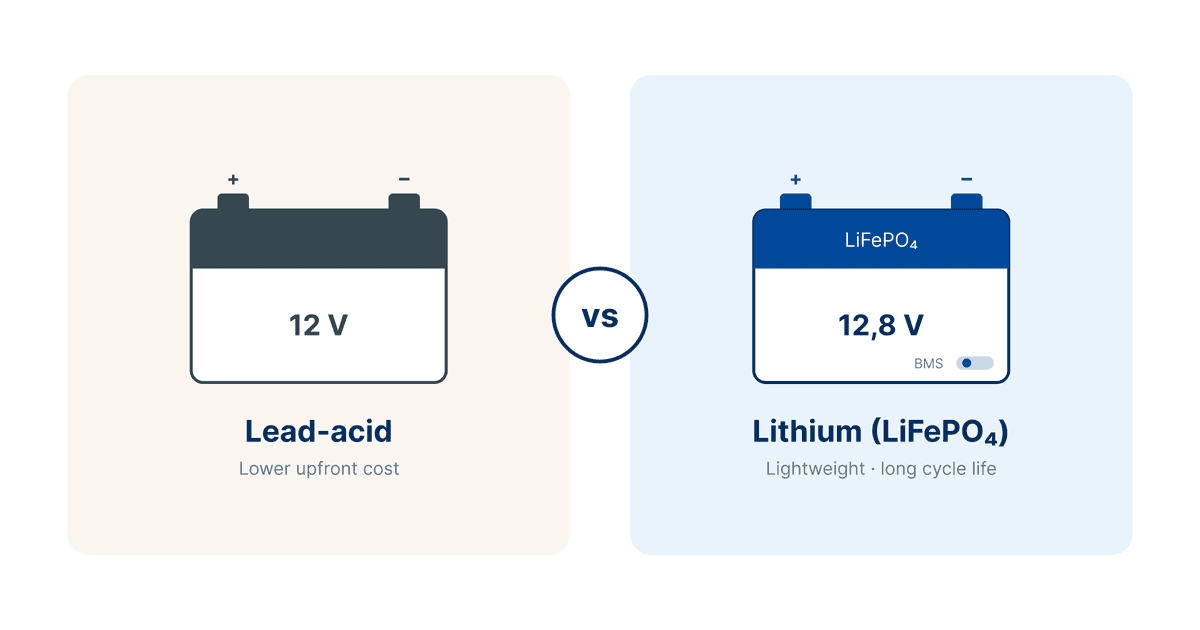
Lithium-ion vs Lead-acid (AGM/Gel) Batteries
When to use which battery?
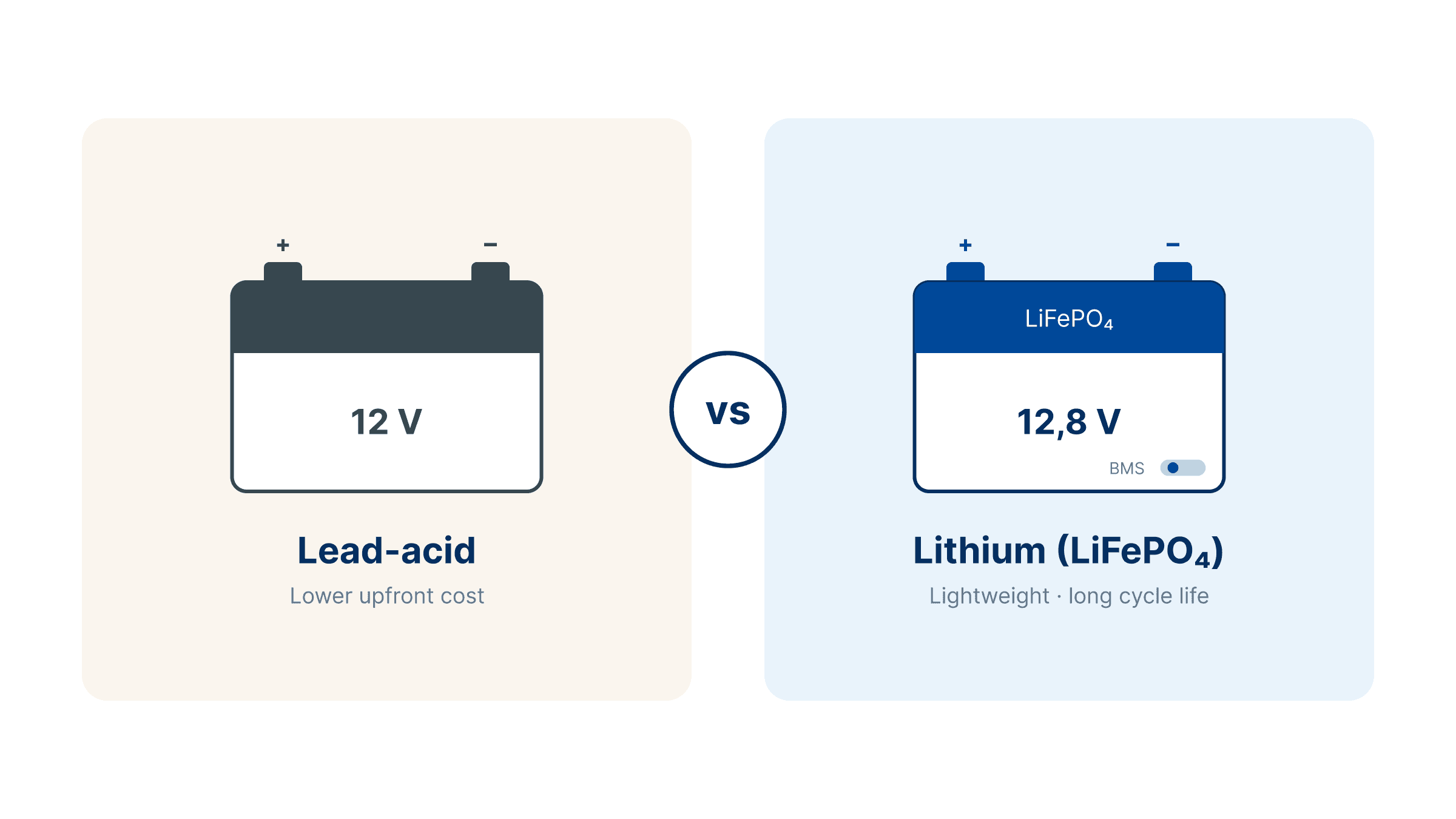
Lead-acid batteries have been the uncontested energy storage choice for well over a hundred years. Lithium ion batteries have been an increasingly popular choice during the last ten. As the cost of lithium batteries continues to fall, users considering a power installation for their home, van or boat are wondering whether to stick with Lead acid, or switch to Lithium ion storage - what are the differences between them?
Lead-acid and lithium batteries differ fundamentally in their chemistry, construction, performance characteristics, and cost. Understanding these differences is essential for choosing the right battery technology for your needs.
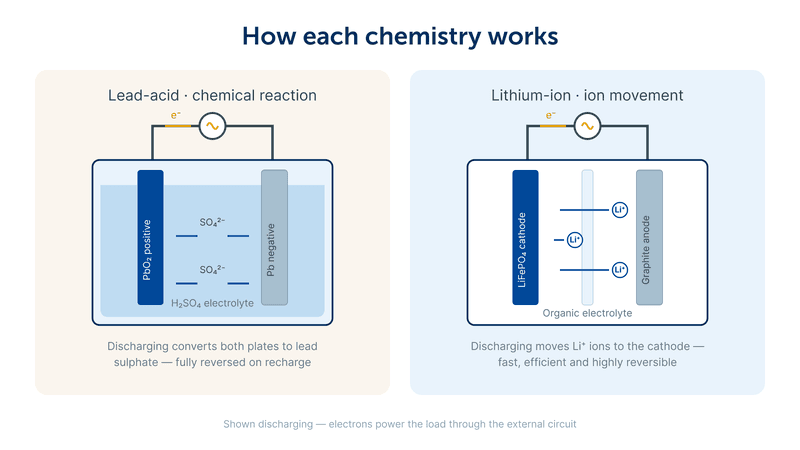
Lead-acid batteries rely on a chemical reaction between lead dioxide (positive plate), sponge lead (negative plate), and sulfuric acid (electrolyte). This reaction creates electrical current through electron movement. When you discharge a lead-acid battery, lead sulphate crystals form on both plates, and when you recharge it, these crystals dissolve. This reversible chemical process has been used for over 150 years and is well-understood and reliable.
Lithium batteries, particularly Lithium Iron Phosphate (LiFePO4), use a completely different chemistry. Lithium ions move between a graphite anode and an iron phosphate cathode through an organic electrolyte. This ion movement is faster and more efficient than the lead-acid process, allowing lithium batteries to charge and discharge more rapidly and with less energy loss. LiFePO4 chemistry is preferred over older lithium-ion types because it's inherently more stable and safer.
Lead-acid batteries are heavy and large due to the dense lead plates and sulphuric acid electrolyte. A typical 200 Ah deep cycle lead-acid battery weighs around 60 kg. Lithium batteries achieve the same capacity with a fraction of the weight because lithium compounds are far less dense. A 200 Ah lithium battery typically weighs 20 kg.
Lead-acid batteries come in flooded (requiring water top-ups) and sealed (VRLA, AGM, gel) varieties (learn more about the different lead-acid battery types). Lithium batteries are always sealed, maintenance-free, and compact. Lithium batteries are around half the volume of equivalent lead acid batteries allowing them to be installed in tighter spaces.
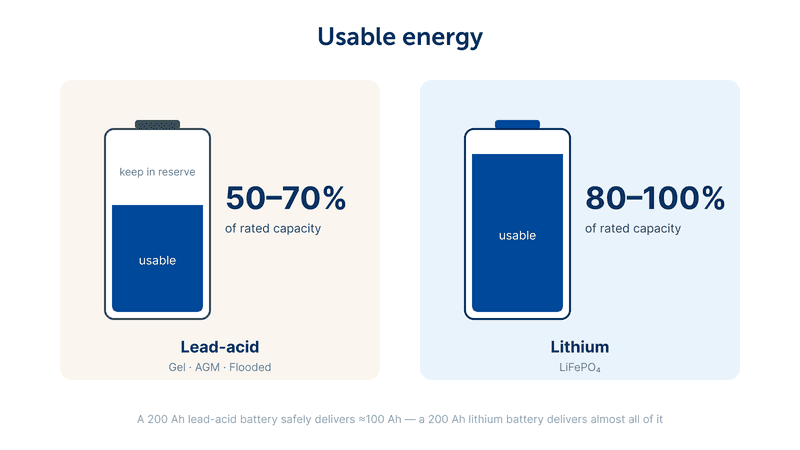
Both battery types are rated in amp-hours (Ah), but there's a crucial distinction: usable capacity. A 200 Ah lead-acid battery provides only about 50% usable capacity in deep-cycle applications, meaning you can safely use only 100 Ah in order to avoid shortening their working life. Lithium batteries, particularly LiFePO4, offer 80-100% usable capacity, meaning a 200 Ah lithium battery delivers almost all its 200 Ah of energy.
This means a 400 Ah lead-acid battery is needed to match the usable energy of a 200 Ah lithium battery. This significantly impacts system sizing, cost, and space.
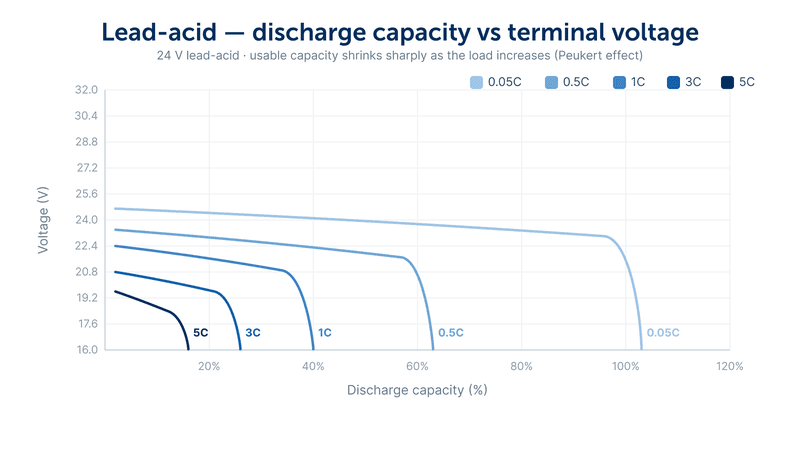
Most Ah ratings of batteries regardless of type are specified at the 20 hour rate. In the image below for the lead acid battery, if that were a 100 Ah battery at a 20 hr rate, you can see that 0.05C means 100 x 0.05 = 5 Amps for 20 hours = 100 Ah available until the battery is totally flat. As we use only 50% of the battery we can see that the voltage will still be 24 V at 50% DOD for a 5 Amp load over 10 hours, and therefore we would have consumed 50 Ah.
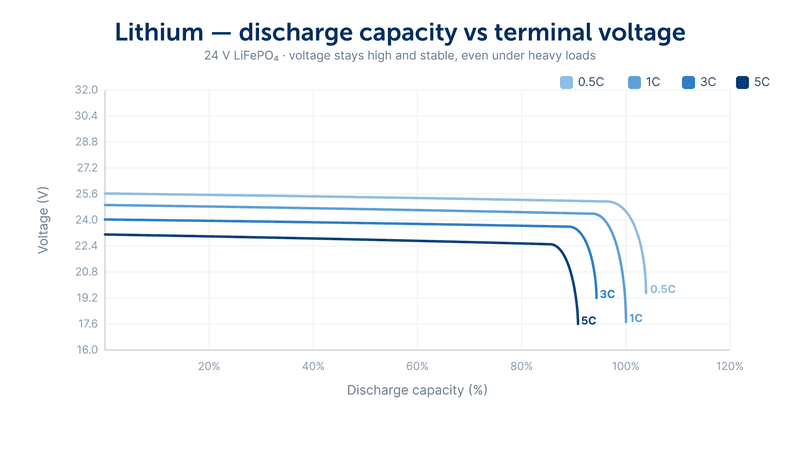
Increasing the current draw (as the graphs below show) can affect the useable energy available and battery voltage. This effective shrinkage in the rating is known as Peukert’s effect. With lead acid the higher the load, the more you need to increase the Ah capacity of your battery to help alleviate this. With Lithium however a load of even 10 times greater at 0.5C can still have a terminal voltage of 24V at 80% DOD/20% SOC, without going up on the Ah rating of the battery. This is what makes Lithium particularly suitable for high loads.
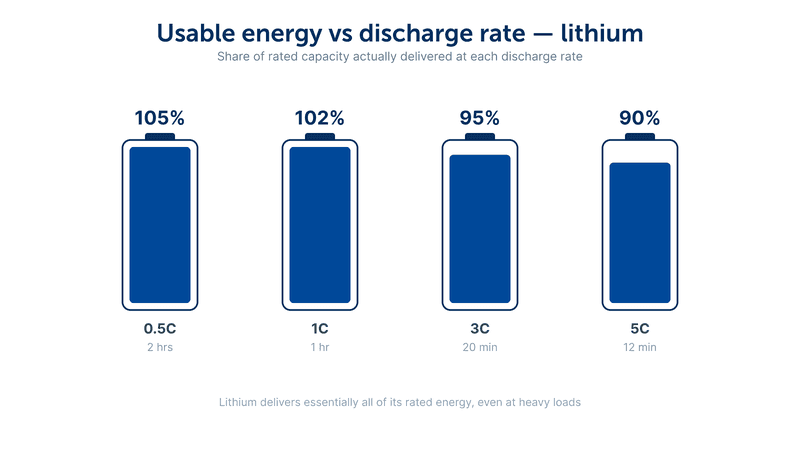
Note: In the graphs below Discharge Capacity vs Terminal Voltage is shown. Usually you will see AGM graphs as Discharge Time vs Terminal Voltage. The reason we plot Discharge Capacity (instead of Discharge Time) is that Lithium has a higher and more stable terminal voltage than AGM, so plotting the curves with Discharge Capacity in mind gives a more accurate comparison of the chemistries, showing that Lithium increases useable energy at higher loads due to higher and more stable terminal voltages. Whilst you may consider this a grey area (in part too due to the varying internal resistance of batteries also) it is probably the only true way to compare the technologies. This is further demonstrated in the images below the graphs.
Lithium – Discharge capacity vs. terminal voltage
Lithium – Useable energy
Lead Acid – Discharge capacity vs. terminal voltage
Lead-acid – Useable energy
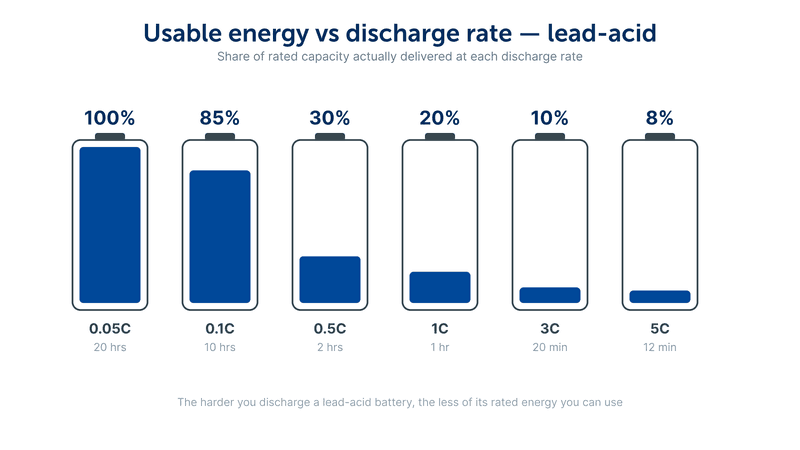
Lead-acid batteries do not deliver their rated capacity when discharged rapidly or exposed to cold temperatures. A lead-acid battery at -10°C provides only 60% of its rated capacity. Lithium batteries maintain fairly consistent performance across a wide range of discharge rates and will retain capacity in cold conditions. However, the battery management system connected to a Lithium battery (*of which, more later) will temporarily disable the battery if the temperature falls below -20°C and will disable recharging if the temperature is below +5°C.
This article provides a deep-dive into lead-acid battery capacity.
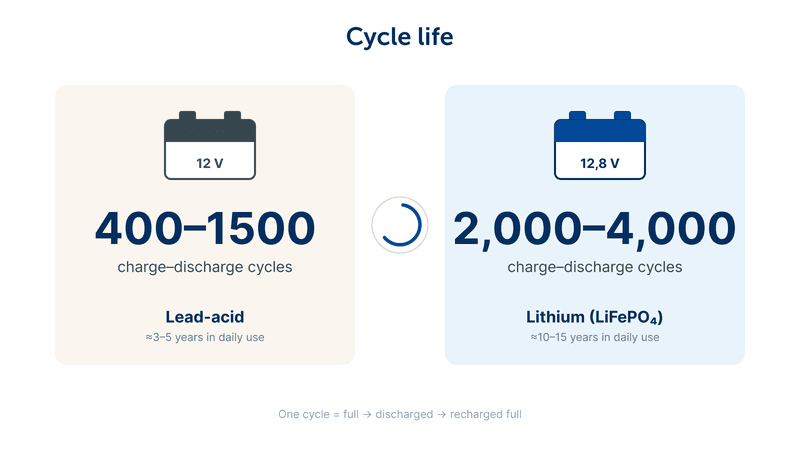
The lifespan difference between lead-acid and lithium batteries is dramatic. Lead-acid batteries deliver 300-500 discharge/recharge cycles, whilst Lithium batteries deliver 3,000 to 5,000 cycles. Understanding why requires examining the chemical degradation processes in each technology.
Lead-acid battery failure occurs through several chemical mechanisms. The primary cause is sulphation—the formation of lead sulphate crystals on the plates. While some crystal formation is normal and reversible during discharge and recharge cycles, over time these crystals become larger and harder, making them increasingly difficult to dissolve during recharge. This permanent sulphation reduces the battery's ability to accept and deliver charge, and thus the lead-acid battery’s lifespan.
Additionally, the lead plates gradually shed material with each charge-discharge cycle, reducing the active material available for the chemical reaction. The positive plate is particularly susceptible to this degradation. Over 300-500 cycles, this material loss becomes severe enough to prevent the battery from holding a charge.
Water loss in flooded lead-acid batteries compounds the problem. The sulphuric acid electrolyte slowly evaporates, especially with frequent charging or in warm conditions. If not regularly topped up, the plates become exposed to air, causing oxidation and permanent damage.
Lead-acid batteries are extremely sensitive to depth of discharge (DoD). Discharging a lead-acid battery below 50% of capacity dramatically accelerates sulphation and material loss. Many lead-acid batteries fail prematurely because users are unaware of this limitation and discharge them more deeply than designed.
To maximise lead-acid battery life users must limit discharge to 50% and absolutely avoid complete discharge. This is why a 200 Ah lead-acid battery effectively provides only 100 Ah of usable capacity.
Lithium Iron Phosphate batteries - LiFePO4 - degrade far more slowly. The lithium-ion movement process is highly reversible, and the iron phosphate cathode is chemically stable, resisting the permanent degradation that plagues lead-acid technology. Even after thousands of cycles, the active material remains available for charging and discharging.
Lithium batteries tolerate almost 100% depth of discharge (DoD), repeatedly, without significant damage. This fundamental chemistry difference is why lithium batteries endure 3,000 - 5,000 cycles.
Lead-acid batteries degrade faster in extreme temperatures. Cold temperatures slow down the chemical reactions, reducing performance and stressing the battery. Hot temperatures accelerate chemical reactions. Battery chargers with battery-temperature sensing should be used - particularly when charging in hot ambient temperatures - failure to do so will result in permanent damage. Most lead-acid batteries are designed for ambient temperatures of, and rated at, 25°C.
Thanks to their lower internal resistance, Lithium batteries are more thermally stable and tolerate a wider operating temperature range of between -20°C and +50°C. It is mandatory that Lithium Batteries have a Battery Management System - this monitors cell voltage and temperature to control charge/discharge rates and, in extremes, enables a battery shutdown before any damage can occur. LiFePO4 batteries maintain capacity over a broader temperature spectrum and degrade less from temperature cycling.
Fast charging lead-acid batteries—charging at high current, especially as the battery approaches full charge—accelerates sulphation and material loss, significantly reducing lifespan. Using a quality battery charger which follows a charging algorithm tailored to the battery type will maximise battery life.
Lithium batteries can tolerate much faster charging because they have lower internal resistance. Charging a LiFePO4 battery at high rates (C/2 or even faster) causes only minimal additional degradation. This means lithium batteries can be rapidly charged when needed without sacrificing longevity.
Yes, much lighter. For mobile applications, battery weight directly impacts fuel efficiency, range, and performance. A 50 kg weight reduction will result in cumulative fuel savings and improved vehicle handling over the many miles an RV might travel during the lifetime of the battery installation.
For fixed installations like off-grid solar power or backup power in buildings, weight and size may be irrelevant. In vehicles additional weight is unwelcome and space will be at a premium, too. On board a boat, heavy batteries may even add to stability if they can be installed below the waterline, but - as with vehicles - making room for them means giving up space for something else.
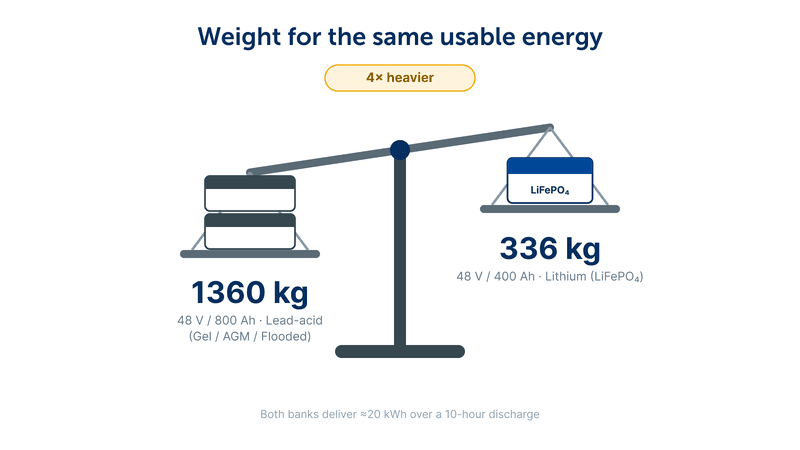
As stated earlier most batteries Ah rating are quoted at the 20 hr rate. This was fine in the days of light loads, but as the number of loads and the size of loads has increased over time, we also need to look at high short term loads, medium and longer term ones for differing types of equipment. This can mean a large battery pack. At the extremes we might have air conditioning running for 10 hours using 10 kW, compared to an LED light using 100 Watts in that time. Balancing these differing requirements and all the loads in between becomes key. With a large pack as shown below to achieve this, it becomes clear just how heavy Lead Acid can be compared to Lithium. 1360/336 = 4 times heavier.
Yes, lithium batteries can charge significantly faster than lead-acid batteries, and unlike lead-acid, they can charge at fast rates without serious damage. This difference reflects the fundamental chemistry of each technology.
Lead-acid batteries can only be charged with moderate currents. For a 200 Ah battery, typical charging is 20-40 amps at the bulk charging stage - but as the state of charge approaches 80% and beyond, even that charging current will need to be greatly attenuated. Reaching 100% will take many hours. If the primary charge source is solar panels, during the shorter days of winter it may not be possible to reach 100% state of charge for weeks. Charging at high rates, especially at higher states of charge, can accelerate degradation.
Lithium batteries tolerate much faster charging. LiFePO4 batteries can safely charge at C/2 rate (a 2-hour charge time) or even faster. For a 200 Ah battery, this means charging at 100 amps or more is perfectly feasible - though not recommended for maximum life. If the primary charge source is solar panels, during the shorter days of winter it is far more likely that a 100% state of charge will be reached regularly. If the power source is a generator, run times will be shorter and more fuel efficient. If the power source is the national electricity grid, recharging can be executed during low-cost energy tariffs.
Even at fast rates of charge, lithium battery degradation is minimal—typically less than 5% capacity loss per 1,000 fast-charge cycles.
In real-world scenarios, lithium batteries can fully charge in 25-50% of the time required for lead-acid, and without the penalty of reduced lifespan.
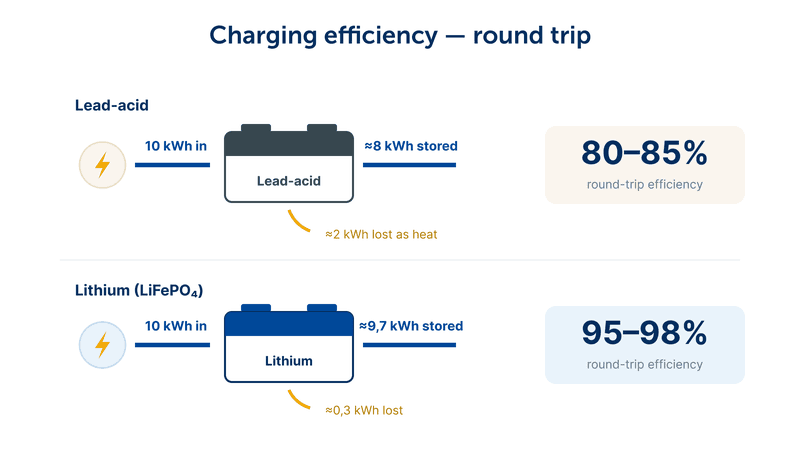
Were you to compare charging a lead-acid and lithium battery with a generator, then the cost savings on fuel would look as follows. Of course, today, a more common practice of charging would be solar. However, this image remains to illustrate the difference between the two battery technologies well.
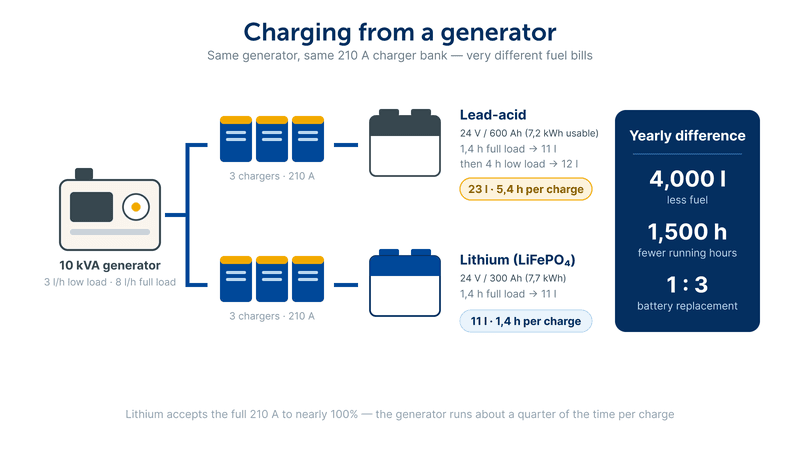
Lithium batteries also charge more efficiently. Lithium IFePO4 batteries achieve 95-98% round-trip efficiency (energy in vs energy out), while lead-acid batteries achieve only 80-85% (less when returning the battery to 100% Soc). This means 15-20% of the energy input to a lead-acid battery is lost as heat during charging and discharging. Over a year of operation, this efficiency difference translates to significant energy waste and increased operating costs.
The following table provides a detailed comparison across key metrics:
The answer depends on your specific application, budget, and priorities. Lithium batteries are superior in many metrics, but lead-acid batteries retain significant advantages in specific scenarios.
While lithium's upfront cost is several times higher than lead-acid, the total cost of ownership often favours lithium over a 10-year period. Consider this scenario: A 10-year off-grid solar installation requires 400 Ah of usable capacity.
In this example, both options have similar total cost, but lithium provides superior performance, requires zero maintenance, and ends the 10-year period with a functional battery. Longer system life or higher usage rates further favour lithium economics.
As Lithium battery prices continue to fall the applications where lead-acid batteries make economic sense shrink. For new installations, the superior performance, lower maintenance, and increasingly competitive cost of lithium batteries position them as the technology of the future for most applications.
Lithium batteries are unquestionably better in performance, lifespan, weight, and maintenance. Lead-acid batteries will remain in use due to their lower cost, in geographical areas of extreme cold where batteries are stored and used outdoors, in regions of low commercial activity where Lithium batteries are seldom available, and among remote users who live self-sufficiently and who prefer hands-on maintenance and control.
Clearly Lead-acid batteries will need to be replaced more often than Lithium. It is worth bearing this in mind as this entails time, installation and transportation costs, which further negates the higher initial capital cost of Lithium, as does the lower cost of recharging Lithium.
No matter what battery choice you make there is also both a capital cost and technological risk at the outset. If you are in a position of having the capital for the higher upfront costs of Lithium, you might find that life is easier and that choice is a cost effective one over time. Much of this depends on the knowledge of the operator and how they treat a battery system. There is an old saying that batteries don't die, they are killed. Good management practices are your insurance against early failure, regardless of the technology used.
Lithium-ion vs Lead-acid? The choice is yours. However, to many it seems that the time is right to consider Lithium as a reliable, high performance solution.
Justin Tyers • 10 August 2026
The most common types of lead-acid batteries
Lead-acid batteries differ in alloy, electrolyte type, and build. Learn which one fits your needs.Need advice? Our highly trained dealers are happy to help with questions, small or large.
Find a dealer near you
Check our support resources or contact your original dealer for dedicated support, repairs or warranty requests.
Support
Read more about our industry-leading 5-year standard warranty and global repair service.
Warranty


©Victron Energy 2026